Use one canonical URL for magnetic car roof signs, car roof magnet signs, car roof magnetic advertising, car roof coroplast magnetic signs, and adjacent car roof magnet sign intents. Run the fit checker first, then review method limits, source evidence, alternatives, and rollout risks before sampling.
The page treats coroplast roof-sign searches as material-specific demand inside the broader magnetic car roof signs cluster. The tool gives immediate fit feedback; the report explains why the answer can change by roof, speed, geometry, and maintenance.
Evidence reviewed and page updated: July 26, 2026. Claims below separate verified sources from items that still require sample testing or customer-supplied vehicle data.

Several buyer questions need evidence boundaries before a roof sign moves from quote to prototype. This section separates method notes, regulatory limits, material assumptions, and environment risks so the checker result is not mistaken for a release certificate.
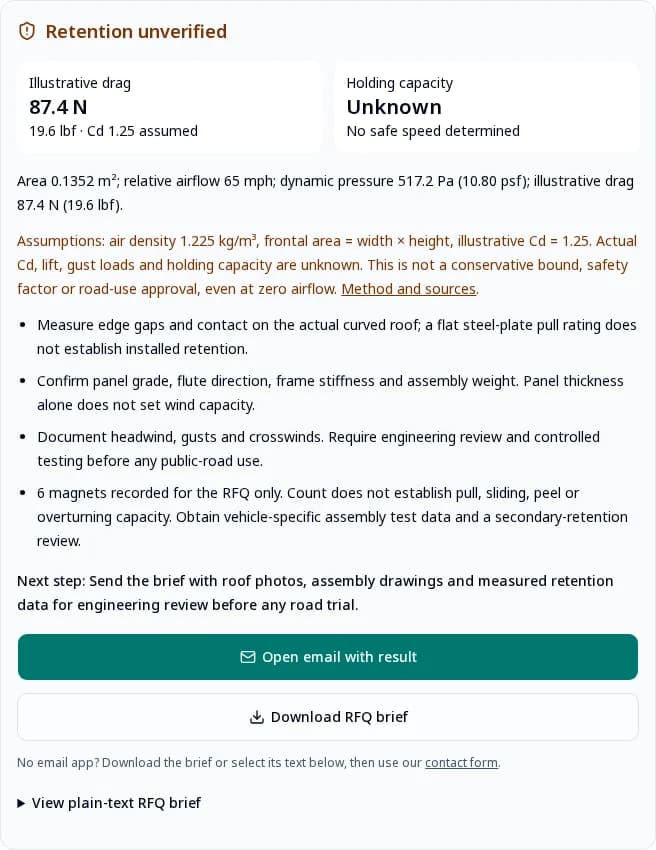
The tool estimates frontal wind load from sign area and route speed, then discounts a nominal magnet reserve for roof curvature, face material, and exposure. It deliberately stops on non-ferrous roofs because a stronger magnet does not solve the missing return path.
Method note: the wind screen follows dynamic pressure logic published by NASA, using velocity squared as the load driver. The result is intentionally conservative because roof curvature, sign-edge separation, drag coefficient, and turbulence are not known from an RFQ sketch.
These boundaries turn the research into RFQ decisions. Where public evidence does not reach magnetic roof-sign certification, the page marks the gap and gives the smallest next test to close it.
| Topic | Known from sources | Pending / not public | RFQ action |
|---|---|---|---|
| Coroplast / corrugated polypropylene | Official Coroplast pages identify print sheets as corrugated polypropylene for graphic arts, with 2-10 mm sheets and stock 4 mm / 6 mm graphic sizes. | No public Coroplast page certifies a 4 mm or 6 mm sheet as safe for magnetic car roof retention at a specific highway speed. | Quote thickness, flute direction, printed face size, frame/rail layout, and supplier data sheet in the RFQ. |
| Aerodynamic load estimate | Dynamic pressure uses velocity squared, so a speed increase materially changes load before magnet count is considered. | Drag coefficient, edge separation, roof curvature, and turbulence are not known from a keyword or simple sign sketch. | Use the checker for screening, then validate with a vehicle-specific road pilot and edge-gap inspection. |
| Magnet material | NdFeB grade, coating, temperature rating, shape, and magnetic circuit affect usable hold and irreversible loss risk. | A nominal pull-force value on a clean steel plate does not predict shear, vibration, heat, or wrapped-roof behavior by itself. | Ask for grade suffix, coating, cup/rail design, pad material, pull test setup, and maximum operating temperature. |
| Vehicle marking rules | FMCSA 49 CFR 390.21 governs required CMV identity markings and allows removable devices when marking requirements are met. | Those rules do not certify a roof-mounted advertising sign or replace state/local advertising and lighting requirements. | Review legal name, USDOT display, side placement, contrast, and local sign rules separately from roof retention. |
| Flexible-sheet care guidance vs Roof wind load | Manufacturer care guidance supports clean, dry, smooth metallic contact, daily removal/cleaning, paint-cure windows, and warnings against horizontal direct-sun surfaces. | It does not certify a coroplast roof sign, magnet rail, edge lift, or highway speed on a curved roof. | Treat flexible-sheet care guidance as a minimum handling boundary, then require a mechanical base or vehicle-specific pilot for roof-mounted highway use. |
| Net wind speed vs vehicle speed | Dynamic-pressure method uses airflow velocity squared, so wind exposure can materially change the load seen by a roof sign. | Public evidence does not provide a universal road-speed rating for every magnetic roof sign geometry, roof curve, magnet rail, and route wind condition. | Enter a conservative maximum route speed in the checker, document route wind exposure, and require a vehicle-specific road pilot before release. |
| Advertising permits vs. Securement | NYC TLC taxicab rules treat rooftop advertising fixtures as authorized equipment with an advertising permit and regulator approval path. | A magnetic sign manufacturer cannot pre-certify each city, taxi, fleet, or private-property advertising approval. | Verify local commercial advertising rules before finalizing the RFQ dimensions or content. |
The strongest evidence is the internal keyword cluster and route assignment. Public regulation sources help frame vehicle-marking and securement risk, but they do not publish a coroplast magnetic roof sign failure-rate table.
Evidence status: no reliable public dataset was found for failure rates by coroplast thickness, magnet count, vehicle roof model, and highway speed. That claim remains pending until it is supported by controlled testing data.
| Source | Detail | Used for | Updated |
|---|---|---|---|
| Internal keyword cluster CSV | data/keywords/car-roof-magnet_broad-match_us_2026-03-25.alias-merge-checklist.csv maps car roof magnetic advertising, car roof magnet signs, car roof magnet sign, and car roof coroplast magnetic signs to magnetic car roof signs. | Canonical URL and alias-merge decision | 2026-03-25 export; reviewed 2026-07-26 |
| OpenSpec alias merge specs | openspec/changes/archive/2026-07-26-add-kw-car-roof-magnetic-advertising-page/specs/rwa-pages/spec.md and the main rwa-pages spec require car roof magnetic advertising to map to /products/magnetic-car-roof-signs with no dedicated route. | Internal link and content placement | 2026-07-26 |
| 49 CFR 390.21 / FMCSA marking rules | CMV markings must appear on both sides, be sharply contrasting, and be legible from 50 ft in daylight; removable devices are allowed only if they meet those marking requirements. | Side-marking compliance boundary | eCFR current to 2026-07-21; checked 2026-07-23 |
| 49 CFR 393.102 securement performance language | Securement performance criteria are useful as safety framing for preventing loss or shifting, but they are not a dedicated magnetic car roof sign test method. | Risk language and method caveat | eCFR current to 2026-07-21; checked 2026-07-23 |
| NASA Glenn dynamic pressure guide | NASA defines dynamic pressure as q = rho u^2 / 2, which supports using speed squared in the wind-load screen. | Wind-load method boundary | NASA page updated 2024-06-28; checked 2026-07-23 |
| Coroplast Print product page and SDS | Coroplast print sheets are polypropylene corrugated sheets, available from 2 mm to 10 mm, with 4 mm and 6 mm stock sizes listed for graphics; SDS revision date is June 7, 2019. | Face-material and RFQ thickness boundaries | checked 2026-07-23 |
| K&J neodymium magnet specifications | Standard N-grade neodymium magnets list 176 F / 80 C maximum operating temperature, while higher-temperature suffix grades extend that limit; actual performance depends on geometry and magnetic circuit. | Temperature and demagnetization risk | checked 2026-07-23 |
| Magnum Magnetics vehicle sign guidelines | Vehicle magnetic signs should be removed and cleaned daily, wiped dry after rain or snow, installed only after paint, clear coat, and wax cure windows, and applied to smooth flat or gently curved metallic surfaces without air pockets. The guidance warns against horizontal metal surfaces exposed to direct sunlight. | Surface prep, cleaning cadence, paint cure, and flexible-sheet use boundary | checked 2026-07-23 |
| NYC TLC Chapter 67 rooftop advertising fixture rules | NYC TLC rules for taxicabs require rooftop advertising fixtures to be authorized, tied to an advertising permit fee path, approved by Safety and Emissions, and supported by engineering certification before use. | Commercial advertising boundary | checked 2026-07-26 |
| Option | Best fit | Main caution | Action |
|---|---|---|---|
| 4 mm coroplast magnetic roof sign | Short campaigns, delivery fleets, removable taxi-style messaging | Needs frame stiffness and verified magnet spacing | Prototype if steel roof and speed margin pass |
| 6 mm coroplast magnetic roof sign | Larger face with better panel rigidity | Higher profile can increase wind leverage | Reduce face area or add retention keepers |
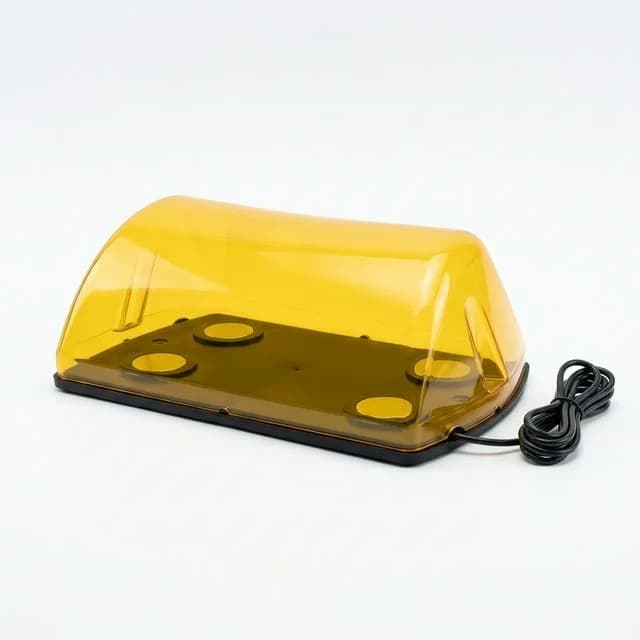
| Lighted acrylic roof sign | Taxi, delivery, or night-visibility programs | Weight, wiring, and box height change the risk model | Use engineered base instead of simple sheet magnets |
| Door magnetic signs | Business identity and DOT-style side markings | Does not answer roof visibility intent | Use /products/magnetic-signs for side-panel checks |
Yes for this cluster. Car roof magnet signs is the plural alias, car roof magnetic advertising specifies the use case, the coroplast phrase describes a common face material, and car roof magnet sign is an adjacent singular phrase. The buyer still needs one magnetic roof sign workflow that can be screened, sampled, and released on the same canonical page.
No. The checker is an RFQ screening tool. Highway release still needs physical samples, vehicle-specific roof checks, pilot testing, and owner approval.
Wind load scales with speed squared. A modest speed increase can consume the magnetic reserve faster than a buyer expects from panel dimensions alone.
Not always. It can improve face stiffness, but it can also increase height, edge leverage, and total assembly weight. The retention system still decides fit.
Not as a magnetic-only solution. Aluminum, glass, composite panels, heavy wraps, and some coatings need a non-magnetic mounting path or a dedicated mechanical base.
Include roof material, vehicle model, sign face size, coroplast thickness, target speed, route exposure, magnet count, cleaning process, and whether car wash removal is required.
No. Side magnetic signs mostly depend on flat door panels and marking content. Roof signs add frontal wind area, roof curvature, and visibility-height requirements.
Use a strap, rail, clamp, adhesive, or purpose-built lighted roof box base. Do not compensate for a failed roof-material screen by simply adding stronger magnets.
For vehicle-mounted magnetic signs, use daily removal/cleaning as the baseline during service, wipe the magnetic side dry after rain or snow, and document pre-install/contact-patch inspection in the SOP. Roof signs still need a stricter pilot because roof wind load is different from side-panel use.
No. The phrases "car roof magnet signs", "car roof magnet sign", "car roof magnetic advertising", and "car roof coroplast magnetic signs" are answered here on /products/magnetic-car-roof-signs to preserve one canonical URL for the intent cluster.
Confirm static fit, edge gap, vibration route, emergency braking, wash/removal workflow, paint marking, and user handling. Record failures by vehicle model and sign geometry.
Use a lighted engineered roof sign when visibility, night operation, wiring, or taxi-style identification matters more than low-cost removable coroplast.
No. While magnets keep the sign on the roof, local municipalities or taxi/fleet regulators determine if you are legally permitted to display commercial advertising on the vehicle. Securement and advertising permits are separate hurdles.
Send the result, roof photos, sign dimensions, coroplast thickness, and route exposure. We will map the sample path without creating a duplicate car roof magnet signs, car roof magnet sign, car roof magnetic advertising, or car roof coroplast magnetic signs page.