RFQ checker + mounting guide

Magnetic car roof signs checker

Check roof compatibility, explore wind drag and prepare a car roof magnetic sign RFQ. No safe speed or holding capacity is inferred.

Car roof magnetic signs RFQ checker

Estimate illustrative wind drag and identify missing mounting evidence. All fields are required; defaults are an example, not a recommendation.

Roof sign details

Airflow is relative to the sign: 65 mph driving + 15 mph headwind = 80 mph for this head-on example. Crosswinds need separate review. Input ranges are tool limits.

Your result will appear here

You will get a wind-drag example, material checks and an RFQ brief. Retention stays unverified until the actual assembly is tested.

Six decisions before ordering samples

By CoatedMagnets. Published: . Page reviewed: . Source check dates appear below. Calculated examples are separated from verified product data and unknown assembly performance.

Material first

Confirm the roof before choosing magnets

Aluminum, glass and composite need a different mounting system. Wrap over steel needs its own interface and finish review; it does not change the underlying steel into aluminum.

Evidence and scope

4 or 6 mm

Coroplast is the face, not the mount

Both thicknesses appear in the Coroplast graphics range. Neither carries a roof-sign road-speed approval. Specify the complete face, frame and mount together.

Evidence and scope

Velocity²

Wind exposure changes the example load

At fixed density, area and drag coefficient, increasing relative airflow from 65 to 80 mph raises calculated drag by about 51.5%. This is a calculation, not a measured vehicle result.

Evidence and scope

Relative airflow

Include headwind in the airflow input

For a direct headwind, 65 mph driving plus 15 mph headwind gives 80 mph relative airflow. This is speed, not force. Crosswinds require a vector assessment; neither this example nor the checker determines a safe driving speed.

Evidence and scope

Pull vs. Shear

Rubber coating trades pull for friction

A rubber layer can improve grip while increasing the distance between magnet and steel, reducing normal pull. The balance depends on the assembly and surface; verify pull, sliding and peel on the intended wet and dry interface.

Evidence and scope

Separate gates

Retention does not grant advertising approval

NYC TLC Chapter 67 §67-16 is one local example requiring authorization for taxicab rooftop advertising fixtures. Check rules for your own vehicle and jurisdiction.

Evidence and scope

Specify the complete roof-sign assembly

Illustration of a roof sign with magnetic mounting pads beneath its base

Concept illustration; not a tested assembly or installation instruction.

Complete roof sign assemblySign face and supporting frameMagnetic base: spacing and contactProtective interface: verify the gapActual roof: material, curvature and finish

A sign face, frame, magnetic base, protective interface and vehicle roof form one system. Submit a drawing showing each layer. Adding a pad or film changes the interface and requires verification.

Method: a load example, followed by an evidence check

The checker uses q = ½ × rho × V² and D = Cd × q × A. V is relative airflow in m/s (mph × 0.44704); A is width × height in m². We assume air density rho = 1.225 kg/m³ and Cd = 1.25 for illustration. The actual coefficient must be established for the assembly. NASA formula reference.

This model excludes lift, overturning, gust response and measured retention. It supplies no safety factor or release threshold. Roof, face and exposure selections generate review questions; magnet count is recorded without assigning a holding force.
  1. Confirm material

    Identify the roof, finish and contact gaps.

  2. Model the load

    Record geometry, relative airflow and assumptions.

  3. Gather evidence

    Request installed retention tests and drawings.

  4. Review before use

    Agree an engineering test plan and release criteria.

Three worked examples

Illustrations, not field trials. All use density 1.225 kg/m³, Cd 1.25 and frontal area 0.1352 m². Values are rounded; no case establishes a safe operating speed.

Worked RFQ examples
ScenarioInputsResultNext action
Curved steel, 4 mm face520 × 260 mm; 65 mph relative airflow; 6 magnetsAbout 87.4 N illustrative drag; retention unverifiedSend curvature photos and installed retention measurements.
Same sign, stronger headwindSame inputs except 80 mph airflow (65 mph road speed + 15 mph headwind)About 132.4 N illustrative drag; about 51.5% higherRevise the wind envelope with the engineer; do not infer a safe speed.
Aluminum roofSame dimensions and airflow as the first exampleMagnetic-only mounting unsuitable; wind example does not establish attachmentRequest a vehicle-approved mechanical mounting option.
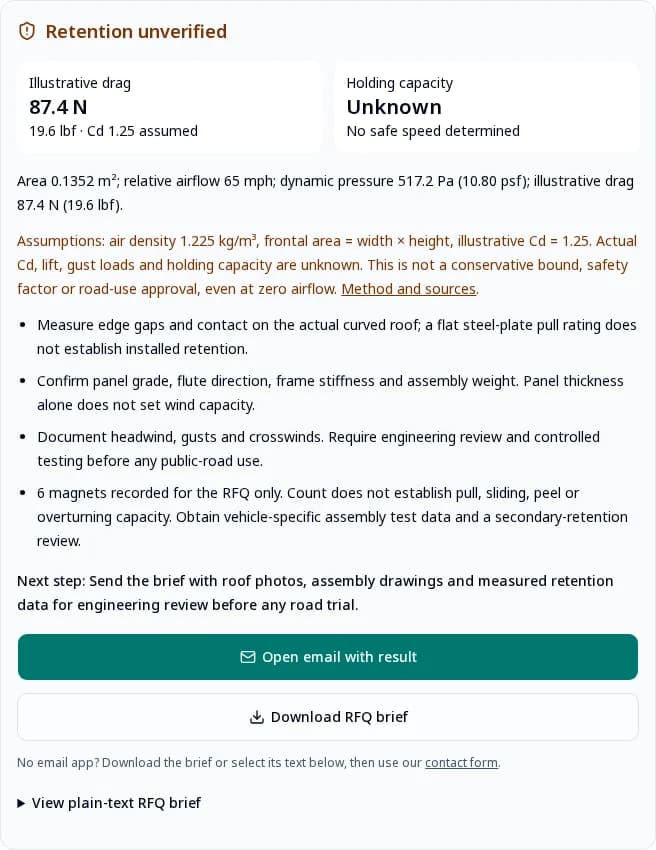
See the actual checker result for the first example
Actual checker output: 87.4 N illustrative drag, unknown holding capacity and an RFQ download
Captured from this tool on September 20, 2026 using the first example’s inputs. Run the checker with 520 × 260 mm, 65 mph relative airflow and 6 magnets to reproduce it. This is software output, not a vehicle test or verified retention.

Use your own dimensions to prepare a brief with the calculation assumptions and the evidence your supplier needs.

Build your roof sign RFQ

Known inputs and evidence still needed

Formula
Published
NASA dynamic-pressure and drag equations.
Drag coefficient
Assumed
1.25 for the example; actual value unknown.
Installed capacity
Unknown
Needs vehicle-specific assembly tests.
Evidence boundaries
TopicKnownUnknownMinimum next step
Steel roof and protective layersA magnetic interface requires a suitable substrate and contact.Actual roof steel thickness, curvature, wrap gap and finish compatibility.Confirm material and inspect contact on the vehicle; get wrap-maker approval where applicable.
Wind and geometryThe checker uses frontal area and relative airflow with explicit assumptions.Actual Cd, lift, turbulence, gust response and overturning moment.Ask an engineer to assess the complete assembly; do not treat the example as an upper bound.
Pull versus sliding or peelNormal pull is a different load direction from sliding or edge lift.Vehicle-specific retention capacity, friction and uneven load sharing.Require separate installed pull, sliding and peel tests with the intended pads and finish.
Face materialCoroplast stocks multiple sign-sheet thicknesses.Stiffness, flute orientation, frame behavior and complete assembly weight.Provide the panel grade and drawing; do not assign a safety factor solely from thickness.
Heat and exposureMagnet grade and flexible-sheet care have published limits.Supplier-specific adhesive, pad, coating, and printed-face limits.Obtain every component data sheet and test the intended environment.
Public-road release and certificationThe checker organizes an RFQ; it does not certify an assembly.A verified operating envelope and applicable approval requirements for your vehicle, sign and jurisdiction.Request the exact model, vehicle fit, test conditions and limitations behind any certification claim. Require engineering review before a public-road trial.

Compare mounting and face options

Select for the vehicle and use case first. Each option needs its own supplier data and installation approval; these comparisons do not rank safety.

Roof sign alternatives
OptionUseful forTradeoffAction
4 mm coroplast assemblyRemovable messaging where a supported lightweight face is suitableNeeds a frame and validated mountQuote complete face/frame/base; verify installed behavior.
6 mm coroplast assemblyProjects that need a different panel stiffness or constructionThickness alone proves neither higher wind area nor safer retentionCompare mass, stiffness and frame details using supplier data.
Lighted acrylic roof boxNight visibility or taxi identificationAdds wiring, mass, height and enclosure constraintsUse a purpose-built vehicle mounting review.
Vehicle-approved rail or clampNon-ferrous roofs or projects lacking magnetic test evidenceFit and vehicle load limits still applyConfirm approved attachment points and assembly limits.
Door magnetic signsSide-facing business identityDoes not provide roof-level visibilityReview side-panel magnetic signs

Control misuse and exposure risks

Misuse: road speed mistaken for wind exposure

A direct headwind increases relative airflow. At otherwise fixed inputs, drag rises with the square of that airflow. Neither road speed nor magnet count establishes installed retention.

Action: Ask for assembly-specific wind and retention tests, including gust and crosswind conditions. Follow the assembly maker’s operating and removal limits; keep unverified assemblies off public roads.

Scene mismatch: wash and severe weather

A dry stationary fit does not cover automated washing, ice, grit or salt.

Action: Remove before automated washing unless the assembly maker explicitly permits it; inspect before reinstalling.

Paint and wrap damage

Debris and trapped moisture can harm the contact surface.

Action: Follow the actual assembly and finish manufacturers. Do not extend flexible-sheet guidance into roof-mount approval.

Heat and adhesive failure

A magnet-grade temperature figure does not establish the limits of pads, adhesives or printed faces.

Action: Collect supplier-specific service limits and select an assembly validated for the operating environment.

Material boundaries: magnet temperature specifications and flexible-sheet care restrictions. These do not replace complete-assembly instructions.

Budget beyond the printed sign

Prices and failure rates are unknown without a project quote and test data. Compare these cost drivers instead of assuming the cheapest face produces the cheapest fleet program.

Cost and procurement risks
Cost driverWhat changes itBuyer action
Prototype and test budgetRoof models, base design, fixtures and repeat testsPrice a representative sample/test phase before the production order.
Handling laborRemoval, cleaning, inspection and storage frequencyTime the actual operator workflow in a controlled pilot.
Replacement and finish repairPad wear, trapped grit, adhesive aging and roof finishDefine inspection/replacement criteria and responsibility in the quote.
Permit or design changesVehicle class, operating location and advertising contentConfirm local requirements before printing inventory.

Traceable sources and their limits

Sources establish formulas, product properties and specific regulatory boundaries. None of the sources below establishes a universal magnetic roof-sign failure rate, holding capacity or safe speed.

Sources checked September 20, 2026
SourceEvidenceScopeDate
NASA Glenn — Dynamic Pressureq = ½ × rho × V² defines dynamic pressure. Pressure is not total sign force.Physical relationship; no roof-sign ratingChecked September 20, 2026
NASA Glenn — Drag EquationD = Cd × q × A; the coefficient depends on geometry and the chosen reference area.Formula only; our Cd = 1.25 is illustrative and unvalidatedChecked September 20, 2026
Coroplast — Print specificationsLists 2–10 mm print sheets, including 4 mm and 6 mm graphics stock.Available face thicknesses, not vehicle retentionChecked September 20, 2026
K&J — Leverage and friction when using magnetsExplains how a high-friction layer can resist sliding while the added separation reduces normal pull. Its wall-mount examples are not vehicle tests.Qualitative tradeoff only; actual wet/dry roof retention needs testingUpdated August 27, 2025; checked September 20, 2026
NASA Glenn — Relative VelocityAirspeed is the vector difference between ground velocity and wind velocity. Direct headwind adds to forward speed in the one-dimensional example.Relative-airflow input only; not a force, gust model or safe-speed ratingChecked September 20, 2026
K&J — Neodymium specificationsLists 80°C for standard N material and notes that geometry and magnetic circuit affect actual performance.Magnet-grade boundary, not a whole-assembly heat ratingChecked September 20, 2026
Magnum Magnetics — Clean & CareFlexible vehicle magnets should be removed and cleaned daily. The manufacturer warns against horizontal direct-sun surfaces and requires full contact with a suitable surface.Flexible-sheet handling limits; not approval for a rigid roof assemblyChecked September 20, 2026
49 CFR 390.21T — CMV markingsFor covered self-propelled CMVs, required markings generally go on both sides, with contrast and daylight legibility at 50 ft. See the rule for exceptions.Side-marking requirements, not roof-sign certificationChecked September 20, 2026
NYC TLC Chapter 67 §67-16Sets authorization, permit, testing/certification and Safety and Emissions approval requirements for the covered taxicab rooftop advertising fixtures.NYC taxicab example only; not a universal sign permit rulePDF updated October 24, 2025; checked September 20, 2026

Magnetic car roof signs FAQ

What should I check before ordering car roof magnetic signs?

Confirm the roof material, face size, assembly weight, relative airflow and installed mount test evidence. Use the checker to assemble those questions into an RFQ before ordering a prototype.

Are car roof magnetic signs and car roof magnetic advertising different products?

The first phrase describes the mounting approach; the second describes the use. A coroplast magnetic roof sign still needs the same roof, structure and mounting review, plus any local advertising authorization.

Can this checker certify a sign for highway use?

No. It calculates an illustrative drag load and flags missing information. It cannot determine holding capacity, a safe speed, a safety factor or road-use approval.

Does adding magnets make the result safe?

No. Count is recorded for the RFQ only. Grade, gaps, load directions and spacing also matter. Rubber can improve grip while reducing normal pull through added separation; verify the complete assembly on the intended surface rather than assuming a universal benefit.

Which speed should I enter?

Enter airflow relative to the sign. For a direct headwind, 65 mph driving plus 15 mph headwind gives 80 mph relative airflow. That is a speed, not a force; force is reported in N or lbf. Crosswinds, gusts and local roof flow need separate review.

What does the assumed drag coefficient mean?

Cd = 1.25 is illustrative, not measured for your sign or a guaranteed conservative bound. Geometry, orientation and reference area affect Cd. A certification label alone supplies neither Cd nor transferable speed approval; ask for the exact assembly test report.

Can I use a magnetic sign on an aluminum or glass roof?

A magnetic-only attachment does not have a steel contact path there. Ask for a vehicle-approved rail, clamp or other mechanical system rather than adding stronger magnets.

What if the roof is wrapped steel?

The steel may still attract a magnet, but the wrap adds a gap and potential finish damage. Obtain compatibility guidance from the wrap maker and test the complete installed interface.

Is 6 mm coroplast safer than 4 mm?

Thickness alone cannot answer that. Compare the sheet grade, stiffness, flute direction, mass and frame. Neither thickness establishes the capacity of the mount.

Can the sign stay on during a car wash?

Remove it before automated washing unless the manufacturer explicitly permits that exposure for the complete assembly. Follow its removal and reinstallation procedure.

Can I use ordinary flexible magnetic sheet for the roof?

Do not assume so. Magnum warns against horizontal metal surfaces in direct sun for its flexible sheets. A rigid roof sign needs a suitable purpose-built mounting system and separate evidence.

Does this replace required commercial vehicle side markings?

No. Covered CMVs must meet the applicable identification and placement provisions of 49 CFR 390.21T. Roof advertising and required vehicle identity markings are separate decisions; check the current rule and its exceptions for your vehicle.

What should I send with the RFQ brief?

Attach vehicle make/model, roof photos, material and finish details, face/frame drawings, total weight, mount specification, intended wind/weather exposure and available test reports. The brief can be downloaded or opened in your email app.

Turn the result into an engineering brief

Run the checker, download the result, and attach roof photos, vehicle make/model, face and frame drawings, assembly weight, proposed mount details and existing test reports. Review the test plan before a road trial or bulk order.