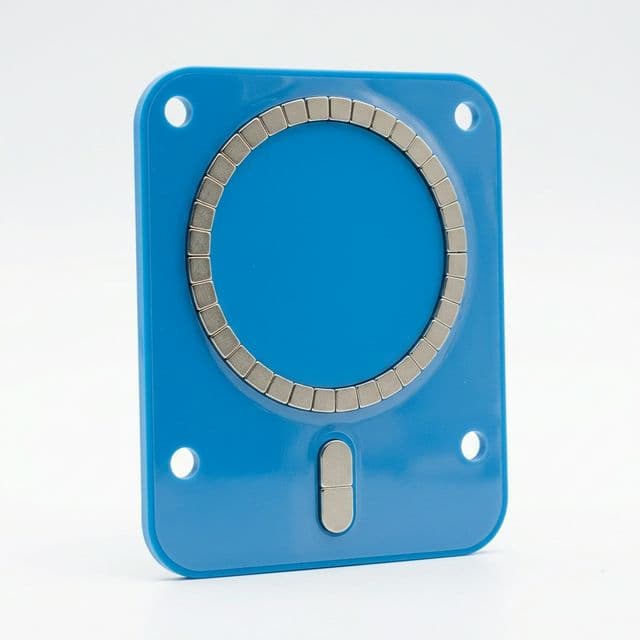
If you searched for antenna magnetic mount or antenna magnet mount (including shorthand antenna mag mount), this is the canonical page you want. Use the selector first to shortlist the mount class, then use the report layer to verify why the fit changes with roof material, connector family, and antenna length.
Use the real installed length or the closest planned whip length, not the package name. This pre-screen accepts 0.1 to 12 ft.
The logic is intentionally conservative because connector fit, roof material, and real antenna drag break weak assumptions fast.
Empty state
Start with the roof and connector, not the marketing label. The tool then tells you whether a single base, triple base, articulated plate, or non-magnetic alternative is the right direction.
Published signals in the page are product-specific references reviewed on 2026-04-06, not a universal field rating for every mount sold under the phrase "magnetic antenna mount."
This tool pre-qualifies fit. It does not certify final retention, grounding, or RF performance for high drag, off-road, or HF installs.
Alias demand
30/mo
US search volume in the current keyword set: "antenna magnetic mount / antenna magnet mount" alias cluster 30/mo.
Canonical demand
90/mo
US search volume for "magnetic antenna mount" in the current keyword set.
Triple footprint
3 x 90 mm
Chelegance publishes a three-magnet triangular base at 90 mm per magnet.
Single-base ceiling
3 to 4 ft
Firestik K-11 publishes shorter-whip guidance instead of a universal one-size-fits-all claim.
NMO metal envelope
3/4 in + 0.046 in
PCTEL NMO-style mounts publish a 3/4 in hole, 1-1/8 in-18 thread, and metal thickness to 0.046 in.
Thick-plate envelope
3/16 to 1/2 in
As of 2026-04-06, TE NMO through-hole references publish thick-plane options from 3/16 to 1/4 in and adjustable variants up to 1/2 in plate thickness.
Drag step-up
1.86x
Using NASA drag equation scaling, moving from 55 mph to 75 mph increases relative aerodynamic load by about 1.86x (same antenna profile and air density).
Cable route stiffness delta
2x bend moment
As of 2026-04-06, Times Microwave publishes the same 0.75 in minimum bend radius for LMR-240 and LMR-240-UF, but about 2x bending moment (0.25 vs 0.125 ft-lb).
900 MHz, 18 ft loss spread
1.26 to 2.47 dB
Across published cable data in this page update, 18 ft insertion loss spans from ~1.26 dB (LMR-240) to ~2.47 dB (RG-58 baseline).
Published speed ratings
0/7 pages
Across seven reviewed product and mount-reference pages, no explicit vehicle-speed retention rating is disclosed (updated 2026-04-06).
FCC mobile boundary
20 cm
As of 2026-04-07, FCC Part 2 uses 20 cm as the mobile-versus-portable RF exposure boundary.
Part 95 power spread
2 W to 50 W
As of 2026-04-07, reviewed FCC Part 95 services span from 2 W (MURS) to 50 W (GMRS main-channel mobile/base/repeater), with CBRS at 4 W AM/FM or 12 W SSB PEP.
It will tell you which mount class is most defensible for the roof, connector, and antenna length you entered.
It will tell you when a triple base or custom plate is a better fit than a single base.
It will not certify a non-magnetic roof, an HF system, or a rough-service install without a deeper review.
This summary compresses the page into the key buying conclusions, then makes the fit boundaries visible before you move into the deeper comparison and evidence sections.
Steel roof or tank where a drilled mount is not acceptable.
Medium or larger antennas that have already outgrown casual single-base assumptions.
Temporary or semi-permanent installs where cable routing and removal still matter.
Aluminum, fiberglass, panoramic-glass, or hidden-roof structures.
HF or rough-service jobs where ground path and vibration become system-level risks.
Long or top-loaded whips that need a fleet-standard permanent bracket or drilled roof.
The selector gives the immediate answer. The report layer below explains the logic, shows the published hardware examples refreshed on 2026-04-06, and makes the boundary conditions visible before an RFQ is sent.
| Product | Footprint | Interface | Cable | Published note |
|---|---|---|---|---|
| Firestik K-11 | 4.9 in single base | Mount-end ring / radio-end PL-259 | 18 ft | Published recommendation up to 3 ft Firestik / II and up to 4 ft Firefly / Road Pal. |
| MFJ-335BM | 5 in single base, 2 1/2 lb | NMO | with cable | Published as medium-to-heavy-duty for medium to large antennas. |
| Chelegance JMOUNT-3HD | 3 x 90 mm triangular base | SO-239 to PL-259 | 5 m RG58 | Published as heavy-duty support for large antennas with rubber protection. |
| MFJ-336T | Three 5 in magnets on 1/4 in plate | 3/8-24 | 17 ft | Published as Goliath tri-magnet mount and warned as difficult to remove once placed. |
| Antenna Products MagMount X | 3 x 88 mm magnets, 18.38 in max width | 4-hole bolt circle | custom top interface | Published for magnetic-friendly surfaces with articulated magnets for slight curvature. |
| MFJ-330 ground plane pad | Adjacent accessory | SO-239 magnet systems | n/a | Published to strengthen HF magnet-mount signal when direct chassis ground is unavailable. |
| PCTEL NMO style mounts | 3/4 in hole, metal thickness to 0.046 in | 1-1/8 in-18 thread | mount hardware envelope | Published mechanical boundary for NMO-style mount hardware and panel thickness. |
| PCTEL no-ground-plane elevated-feed series | Mirror/trunk-lid and non-metallic scenarios | 1-1/8 in-18 thread ecosystem | model-specific | Published counterexample path where no ground plane is available, especially LTE/cellular mobile families. |
Every row below can still be a valid answer for the broader query. The real choice is whether the install needs a single footprint, a triple footprint, or a custom plate on a truly magnetic surface.
| Platform | Best when | Hardware path | Published signal | Watchouts |
|---|---|---|---|---|
| Single heavy NMO base | Short to medium antennas, flat steel roof, and a no-drill road install. | NMO connector path. | MFJ-335BM: 5 in base, 2 1/2 lb weight, medium-to-heavy-duty, medium to large antennas. | Still a single footprint. Do not treat it as interchangeable with a triple base. |
| Single heavy stud base | Shorter 3/8-24 whip installs where removal speed matters more than the biggest footprint. | 3/8-24 stud with coax lead to the radio. | Firestik K-11: 4.9 in base, 18 ft coax, up to 3 ft Firestik / Firestik II or 4 ft Firefly / Road Pal. | Published guidance is explicitly shorter-whip territory, not a blank check for larger antennas. |
| Triple SO-239 base | Larger temporary installs where the antenna expects SO-239 and the roof is still ferrous. | SO-239 at the mount, PL-259 on the radio side. | Chelegance JMOUNT-3HD: 3 x 90 mm magnets, 5 m RG58, rubber boots, large-antenna positioning. | Paint, curve, and highway drag still need a placement test even on a wider base. |
| Triple 3/8-24 platform | Stud-based whips that have already outgrown a single-magnet answer. | 3/8-24 stud on a triangular plate. | MFJ-336T: three 5 in magnets on a 1/4 in triangular mount with 17 ft coax. | Strong hold does not remove HF, off-road, or grounding boundaries. |
| Articulated custom plate | Custom bolt-circle antenna feet, slightly curved steel, or industrial temporary installs. | 4-hole bolt circle / custom top plate. | Antenna Products MagMount X: 3 x 88 mm magnets, 3 x 411 N grip force, 12 ga steel body, rubber contact. | This is still limited to magnetic-friendly surfaces and product-specific geometry. |
| No-ground-plane elevated-feed fallback | Vehicle surface is non-magnetic and the antenna family has a published no-ground-plane option. | 1-1/8 in-18 thread mount ecosystem; mirror/trunk-lid style installs. | PCTEL elevated-feed no-ground-plane series publishes use on non-metallic surfaces and mirror/trunk-lid mounting. | This is not a universal rescue path for every band or antenna family. Validate exact frequency model and radiation pattern before reuse. |
Stage1b update (2026-04-06) + regulatory refresh (2026-04-07): this section separates what standards define from what current product pages actually disclose, so buying teams do not confuse catalog specs with validated field limits.
| Standard/source | What it defines | How to use in decisions | Current disclosure gap |
|---|---|---|---|
| IEC 60529 (IP code) | Defines enclosure ingress protection against solids and liquids, with explicit test methods. | Use it to verify weather-sealing claims for outdoor mount assemblies. | Reviewed product pages do not publish a full assembly IP code. Pending confirmation (待确认 / 暂无可靠公开数据). |
| ISO 20653:2023 (road-vehicle IP code) | Defines IP-code requirements and validation tests for electrical equipment used on road vehicles. | Use it when buyers need an automotive-specific ingress benchmark. | No reviewed page discloses ISO 20653 compliance for the mount assembly. Pending confirmation (待确认 / 暂无可靠公开数据). |
| ASTM B117 | Defines salt-spray apparatus and procedure, but does not prescribe product-specific pass/fail life. | Useful only when a seller publishes the exact test duration and acceptance rule. | No reviewed page publishes ASTM B117 hours or acceptance criteria. Pending confirmation (待确认 / 暂无可靠公开数据). |
| ISO 16750-3:2023 | Describes mechanical load stresses and location-based tests for vehicle electrical/electronic equipment. | Use it to evaluate vibration/shock readiness in fleet or rough-service installs. | No reviewed page publishes ISO 16750-3 class-level verification. Pending confirmation (待确认 / 暂无可靠公开数据). |
| NASA drag equation (D ∝ V²) | Shows aerodynamic drag scaling with the square of velocity when shape, area, and air density are held constant. | Use relative speed multipliers to avoid underestimating retention risk in higher-speed duty profiles. | Catalog pages generally do not publish antenna frontal-area + drag-coefficient test sets, so this supports relative comparison rather than absolute force certification. |
| PCTEL NMO and no-ground-plane references | Defines practical mount geometry and no-ground-plane fallback conditions for selected mobile antenna families. | Use to screen hardware compatibility and avoid treating non-magnetic roofs as a single all-or-nothing conclusion. | Band-specific no-ground-plane compatibility for every RF family in this page remains pending confirmation (待确认 / 暂无可靠公开数据). |
| NIST SP 811 (force conversion) | Provides conversion factors including pound-force to newton and vice versa. | Makes pull-force numbers comparable across suppliers that publish N or lbf. | Unit conversion helps comparison, but does not replace dynamic retention testing. |
| TE vehicle-antenna validation scope note (2025) | TE states vehicle antenna portfolios can involve electrical, mechanical, and environmental validation depending on use case, including shock, vibration, wind survival, temperature, and humidity. | Use as an RFQ checklist: request which tests, conditions, and pass/fail criteria apply to the exact mount SKU and installation context. | Reviewed mount listings still do not provide a comparable, SKU-level validation matrix with explicit thresholds (待确认 / 暂无可靠公开数据). |
| PCTEL no-ground-plane MLPV reference | PCTEL publishes a ground-plane-independent low-profile family for no-ground-plane installs, with IP67 claim and 1-1/8 in-18 mount compatibility (including 3/4 in mounts). | This is a concrete fallback path when magnetic hold fails and the selected antenna family is compatible. | It does not prove universal cross-band replacement for every magnetic whip/mount combination; model-by-model RF verification is still required. |
| Service (US FCC) | Published power envelope | Decision impact for mount planning |
|---|---|---|
| CBRS (47 CFR §95.967) | 4 W AM/FM carrier, 12 W SSB PEP | If expected use exceeds this envelope, move to another licensed service path instead of forcing fit around a CB setup. |
| GMRS main channels (47 CFR §95.1767) | Mobile/repeater/base transmitter output up to 50 W | Higher legal power can amplify cable-loss and exposure-planning consequences; keep cable and separation decisions explicit. |
| MURS (47 CFR §95.2767) | Transmitter output up to 2 W | Lower-power envelope can reduce link-margin pressure, but does not remove roof-material and connector-fit boundaries. |
| Amateur service (47 CFR §97.313) | Use minimum necessary power; maximum 1.5 kW PEP with band-specific lower caps | High-power cases should be treated as engineering projects with explicit grounding, exposure, and duty-cycle validation. |
| Band example | §1.1310 basis | Derived planning value | What this changes |
|---|---|---|---|
| 27 MHz (CB region) | General-population 1.34-30 MHz formula from §1.1310: 180/f² mW/cm² | 0.247 mW/cm² (derived at f = 27) | Use frequency-specific math; do not reuse VHF/UHF assumptions on HF/CB bands. |
| 146 MHz (VHF mobile) | General-population 30-300 MHz row from §1.1310 | 0.2 mW/cm² | Common VHF mobile example where a fixed table limit applies without frequency substitution. |
| 462 MHz (GMRS main) | General-population 300-1500 MHz formula from §1.1310: f/1500 mW/cm² | 0.308 mW/cm² (derived at f = 462) | Shows higher allowed power density than VHF row, but still requires separation and exposure review. |
| 915 MHz (ISM/mobile telemetry) | General-population 300-1500 MHz formula from §1.1310: f/1500 mW/cm² | 0.610 mW/cm² (derived at f = 915) | Illustrates that the same formula yields a different planning value as frequency changes. |
| 2.4 GHz and above (up to 100 GHz) | General-population 1500-100000 MHz row from §1.1310 | 1.0 mW/cm² | Use with mobile/portable classification and real antenna placement, not as a blanket safety claim. |
Derived MPE values above are computed from published FCC formulas for planning comparison only. They do not replace a final compliance evaluation for the real installation geometry.
| Road speed | Relative drag load | Decision note |
|---|---|---|
| 45 mph | 1.00x | Baseline for relative aerodynamic load (same antenna profile and air density). |
| 55 mph | 1.49x | Already ~49% above 45 mph baseline in V²-based drag scaling. |
| 65 mph | 2.09x | Crosses ~2x baseline load, often where marginal placements start drifting. |
| 75 mph | 2.78x | About 1.86x the 55 mph aerodynamic load for the same antenna geometry. |
Relative-load table uses NASA drag-equation scaling with fixed geometry assumptions. It is a screening input, not a certified retention test result.
| Cable | 900 MHz attenuation | Approx. 18 ft loss | Published max frequency | Trade-off note |
|---|---|---|---|---|
| Belden 8240 RG-58A/U | 13.7 dB / 100 ft | ~2.47 dB | 4.0 GHz | Baseline in many mobile kits; highest 900 MHz loss among compared options. |
| Times Microwave LMR-195-UF | 13.2 dB / 100 ft | ~2.38 dB | 5.8 GHz | Ultra-flex path with similar 900 MHz loss class to RG-58 in short runs. |
| Times Microwave LMR-240-UF | 9.0 dB / 100 ft (0.09 dB/ft) | ~1.62 dB | 6.0 GHz | Lower 900 MHz loss than RG-58 while keeping ultra-flex construction. |
| Times Microwave LMR-240 | 7.0 dB / 100 ft (0.07 dB/ft) | ~1.26 dB | 8.0 GHz | Lowest loss in this set, but with higher published bending moment than LMR-240-UF. |
Approximate 18 ft losses are derived from published per-foot or per-100 ft attenuation values. Field performance still depends on connector quality, bend radius, routing, and final impedance consistency.
| Cable | Install bend radius | Repeated bend radius | Bending moment | Flat plate crush | Decision note |
|---|---|---|---|---|---|
| Times Microwave LMR-240 | 0.75 in | 2.5 in | 0.25 ft-lb | 20 lb/in | Lower-loss baseline in this page, but with higher published bend moment than LMR-240-UF. |
| Times Microwave LMR-240-UF | 0.75 in | Not explicitly listed on this UF sheet (待确认 / 暂无可靠公开数据). | 0.125 ft-lb | 13 lb/in | Lower bending moment can reduce route stress, but published attenuation is higher than standard LMR-240. |
| Belden 8240 RG-58A/U | 1.9 in | Not disclosed on the reviewed product page (待确认 / 暂无可靠公开数据). | Not disclosed on the reviewed product page (待确认 / 暂无可靠公开数据). | Not disclosed on the reviewed product page (待确认 / 暂无可靠公开数据). | Useful baseline cable, but with both higher loss and larger minimum bend radius in the reviewed data set. |
Stage1b addition (2026-04-06): this mechanical view prevents a common mistake where teams optimize only for attenuation and ignore route stress.
| Boundary fact | Published signal | Decision impact |
|---|---|---|
| NMO mount hardware envelope | PCTEL NMO style mounts: 3/4 in hole, 1-1/8 in-18 thread, metal thickness up to 0.046 in. | If panel stack-up or mount geometry exceeds this range, the install is no longer plug-compatible with standard NMO assumptions. |
| No-ground-plane elevated-feed counterexample | PCTEL publishes elevated-feed antennas that do not require a ground plane and are aimed at mirror/trunk-lid or non-metallic surfaces. | Useful fallback when magnetic roof path fails, but selection remains band- and model-specific (not a blanket replacement for magnetic mounts). |
| NMO thick-plate mount envelope | TE NMO through-hole references list thick-plate variants for about 3/16 to 1/4 in and adjustable versions up to 1/2 in, with standard 17 ft cable and optional 14 ft lengths. | If roof stack-up or adapter hardware exceeds this envelope, switch to another mounting geometry early instead of forcing a nominal NMO-through-hole fit. |
| Stainless family magnetic response | BSSA/ASSDA technical guidance indicates ferritic, martensitic, and duplex stainless families are generally magnetic, while austenitic families are often low-magnetic in annealed state and can shift after cold work. | Treat “stainless” as incomplete information. Run a direct pull check at the final mount location before approving a magnetic install path. |
This table adds an explicit counterexample and keeps its limitations visible: no-ground-plane products can help in specific families, but cross-band equivalence is still pending confirmation (待确认 / 暂无可靠公开数据).
Status: Not disclosed on reviewed product pages as of 2026-04-05 (待确认 / 暂无可靠公开数据).
Decision impact: You cannot defend a universal highway-safe claim from catalog copy alone.
Minimum action: Run on-vehicle speed and reposition checks with a documented pass/fail protocol before release.
Status: Product pages list mechanical details, but no published assembly IP code (待确认 / 暂无可靠公开数据).
Decision impact: Outdoor and washdown durability cannot be compared objectively.
Minimum action: Request IEC 60529 or ISO 20653 test evidence for the full assembly, not only materials claims.
Status: No published ASTM B117 hour data in reviewed pages (待确认 / 暂无可靠公开数据).
Decision impact: "Weather-resistant" statements are hard to benchmark across suppliers.
Minimum action: Require salt-spray duration, failure definition, and post-test function criteria in RFQ.
Status: No reviewed product page states ISO 16750-3 class or equivalent (待确认 / 暂无可靠公开数据).
Decision impact: Rough-road and service-fleet suitability remains uncertain.
Minimum action: Ask for lab reports tied to mounting location and duty profile before committing.
Status: No reviewed source proves that every magnetic-mount antenna family has a no-ground-plane equivalent (待确认 / 暂无可靠公开数据).
Decision impact: Teams may over-generalize one LTE/cellular fallback and miss VHF/UHF/HF compatibility limits.
Minimum action: Require model-level datasheet, supported band list, and radiation pattern before using no-ground-plane as the replacement path.
Status: Compared mount pages still do not publish a consistent test-profile matrix mapped to each SKU (待确认 / 暂无可靠公开数据).
Decision impact: Rough-service and fleet claims are difficult to benchmark across suppliers or product families.
Minimum action: Require test method, condition profile, and pass/fail thresholds tied to the exact part and installation location.
Status: Catalog and mount pages do not disclose actual vehicle panel metallurgy/cold-work condition at the final install point (待确认 / 暂无可靠公开数据).
Decision impact: “Stainless” or “steel” labels can produce false confidence about real magnetic hold.
Minimum action: Perform location-specific hand-magnet and slip checks on the target panel before committing the magnetic route.
This is where the page turns a broad keyword search into an actionable decision. Each case shows what changes first once the roof, connector, and duty profile become concrete.
This section keeps the report honest. The page is only useful if it shows where roof material, connector certainty, and magnetic retention stop being safe shortcuts.
Why it matters: The roof material kills the magnetic path before mount size matters.
How to handle it: Verify the target panel with a test magnet and move to hood, mirror, rack, or drilled mounts when steel is weak or absent.
Why it matters: Published magnetic-mount examples span NMO, SO-239, 3/8-24, and custom bolt circles.
How to handle it: Check the antenna foot or existing hardware first, then choose the footprint that matches the real connector family.
Why it matters: A longer whip on a single base can outgrow the footprint even when the magnet itself feels strong by hand.
How to handle it: Shift from single to triple footprint as length and duty rise, and validate the exact roof location before release.
Why it matters: Curved roofs and coated steel reduce flat contact and can change cable strain and slip behavior.
How to handle it: Use rubber-protected faces where available, but still run a real placement check on the actual vehicle surface.
Why it matters: HF magnet-mount systems may need additional grounding support when a direct chassis path is unavailable.
How to handle it: Treat HF as a boundary case, review ground path early, and use accessories or another mount type when the system requires it.
Why it matters: The reviewed product pages publish dimensions and hardware, but not a standardized vehicle-speed retention rating.
How to handle it: Treat catalog claims as pre-qualification only and require a test-backed speed/duty validation step before deployment.
Why it matters: FCC definitions treat mobile and portable use differently, with 20 cm as the classification boundary in Part 2 references.
How to handle it: Treat antenna-to-occupant separation as a design input from the first layout step and re-check when mount location changes.
Why it matters: No-ground-plane elevated-feed options exist for some antenna families, but they are not universal cross-band replacements for every magnetic setup.
How to handle it: Validate exact band support, connector path, and pattern behavior before replacing a magnetic-mount shortlist with a no-ground-plane model.
Why it matters: Different stainless families have different magnetic response, and cold work can change behavior in austenitic materials.
How to handle it: Do not approve by material label alone. Validate magnetic pull and slip behavior at the exact mount location on the real panel.
Why it matters: A lower-loss cable can still be harder on bends and connectors if routing space is tight or repeated movement exists.
How to handle it: Compare attenuation with bend radius, bend moment, and crush limits before freezing cable spec for door, hatch, or edge routes.
Updated 2026-04-06. The page now combines product-source facts with standards references. Where evidence is missing, the report explicitly marks pending confirmation instead of forcing unsupported conclusions.
Browse all magnetic product pages
Use this hub when you need to compare antenna mounts with other coated-magnet product families.
Compare heavy-duty magnetic antenna mounts
Move here when whip length, speed profile, or retention risk points to wider triple-footprint solutions.
Review threaded magnets for fixture-style mounting
Use this route for hardware-first jobs where threaded retention matters more than temporary antenna placement.
Check magnetic fixture base manufacturing capabilities
Use this page when the requirement shifts from fit screening to supplier process and production constraints.
See automotive accessory mounting scenarios
Use this scenario page to align vehicle-use constraints with coating, durability, and mounting trade-offs.
Send your mount inputs for engineering review
Share roof type, connector path, and duty cycle to convert shortlist outputs into a reviewed recommendation.
These answers are written to cover the exact alias intent and the broader magnetic antenna mount keyword without splitting them into competing URLs.
Send the roof material, antenna length, connector family, and daily use profile. That is the minimum detail needed to move from a keyword-level answer to a real mount recommendation with boundaries and alternatives.
If your shortlist already points to larger whips and wider footprints, continue into the dedicated heavy-duty magnetic antenna mount page for triple-platform narrowing.
If your next decision is about threaded holding magnets rather than vehicle antenna mounts, the adjacent guide on threaded magnets covers hardware-first mounting jobs.